
Nobody was ever made customer-centric by downloading a template.
There is a folder on basically every CX Pro's drive with roughly the same contents. A journey-map template. A persona template. A service blueprint. A voice-of-customer framework you downloaded two years ago. Each was looked at once, maybe used once, and has not been opened since.
This is not an argument against templates. In some areas they are among the most reliable interventions anyone has ever measured. It is an argument about what happens when a template stops being a place to start and actually becomes the thing you deliver.
A filled-in template looks exactly like finished thinking. It has boxes, and the boxes are full. Nobody in the room can tell whether what sits behind it took six weeks of customer interviews or one afternoon and a confident guess.
What a template is actually for
Start with the case where templates work, because it is a strong one and it explains the rest.
In 2009 a nineteen-item surgical safety checklist was tested across eight hospitals on four continents, in settings ranging from well-funded teaching hospitals to resource-poor district ones. Complications and deaths both fell[1] It is one of the most cited results in patient safety, and it is a template in the plainest sense: a printed list of boxes that somebody ticks.
Look at why it worked. The surgical team already knew what to do. Every item on that list was something a trained clinician could recite from memory. The failure mode was never ignorance. It was omission under pressure, at three in the morning, in a room where the senior person is not to be interrupted. The checklist is a defense against forgetting, and against the social cost of speaking up.
That is the condition. A template earns its place when the task is well understood and the risk is that a known step gets skipped.
Where the analogy breaks
Now put a journey-map template in front of a team that has never mapped a journey.
They are not at risk of forgetting the stages of their customer's experience. They do not know them yet. Finding out is the entire reason the exercise exists.
Hand someone a shape to fill when they do not yet have the content, and you will get a filled shape. It will be tidy. It will present well. It will also be fiction, assembled from what the people in the room already believed on the morning they walked in.
The template answered the question "what should the output look like." The question on the table was "what is actually happening to our customer." Those are not the same question, and only one of them is hard.
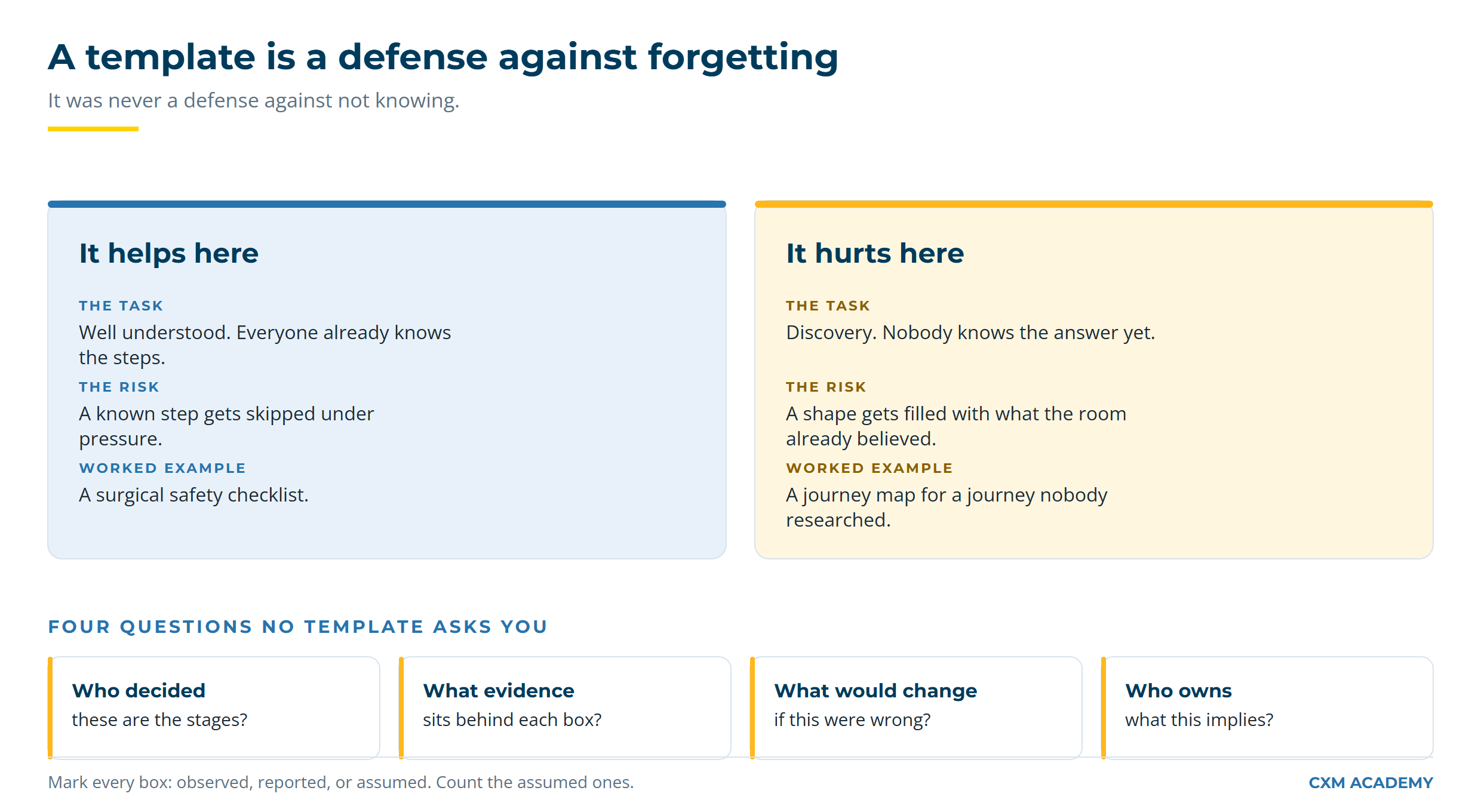
Two conditions for using a template. It helps when the task is known and the risk is skipping a step. It hurts when the task is discovery and the risk is not knowing. Underneath, four questions no template asks.
The moment the template becomes the deliverable
You can spot it without being told. The map on the wall that nobody has changed in fourteen months. The persona with a stock photograph, a first name, and a favorite coffee order, and no evidence behind any of it. The blueprint with swim lanes and no owner in any of them.
We have said the sharper version of this before: a journey map on the wall that gets called a strategy is a to-do list wearing better clothes.
Personas show the pattern most clearly. A useful research-based persona has five layers: demographic, behavioral, functional, emotional, and the job the customer is trying to get done. Most persona templates have boxes for the first three, because those are the ones that are easy to specify in advance. So most personas stop at three. A persona that stops at layer three tells you what the customer is like. One that reaches layer five tells you what they are hiring you for, which is the only layer that changes a decision.
The template did not hide layers four and five. It just never asked, and nobody noticed the question was missing.
Why this spreads faster than the alternative
An artifact travels. Reasoning does not.
A template is a file. It can be shared in a channel, attached to an email, posted to a network, and reused by somebody who was not in the room. The thinking that should sit underneath it has no such format. There is no download for "we interviewed nineteen customers and three of them said something that broke our assumption."
So the artifact spreads at the speed of a link and the thinking spreads at the speed of an apprenticeship. Over a few years, that difference compounds into a profession where a great many people own the same twelve files and a much smaller number can say why any box on them is there.
It is also, and this matters, a generous act. People share templates to help. Nobody is being cynical. That is exactly why the pattern is hard to see and harder to argue with.
And now the templates fill themselves in
For twenty years the friction in this system was that somebody still had to type. Filling in a persona template badly took an afternoon, and an afternoon is long enough for at least one person in the room to say out loud that they are making it up.
That friction is gone. Ask any general-purpose model for a customer journey map for a mid-market insurance renewal and you will have six stages, emotional highs and lows, pain points and opportunities, in about nine seconds. It will be coherent. It will be well written. It will be built entirely from the average of everything ever published about insurance renewals, which is to say from everybody's customers and therefore from nobody's.
This is the specific danger. The output is no longer merely unevidenced; it is unevidenced and fluent, and fluency is what most stakeholders use as a proxy for rigor. A rough hand-drawn map with three quotes stuck to it is worth more than a polished generated one, and it will lose the meeting.
None of which is an argument for doing the work slowly. Use the model to draft the structure, to challenge your stages, to argue with your findings. Just never let it supply the findings, because the one thing it cannot do is have talked to your customer last Tuesday.
The skill you quietly stop practicing
There is a well-known result in the automation literature that transfers here almost without modification. When you automate the routine parts of a job, the human is left responsible for precisely the parts that could not be automated, but with far less day-to-day practice at the underlying skill. The operator is asked to be excellent at the hard case, having spent months not doing the easy one[2]
A template does the same thing to analytical work. It automates the structuring: what the categories are, what order they go in, what counts as a complete answer. Structuring is the part where the thinking happens.
Cognitive science has a name for the general move. We routinely offload cognitive work onto external artifacts, which is efficient and often correct, and the artifact then quietly bounds what gets considered at all.[^3] A template is an offload with a strong opinion. It answers "what should I be asking here," once, permanently, in the shape of its own boxes.
Four questions a template will never ask you
Ask these of the last completed template on your drive.
Who decided these are the stages? Every journey template ships with a default arc. Awareness, consideration, purchase, onboarding, support, renewal. Your customer has never heard of it. Whose journey is this, theirs or the template author's?
What evidence sits behind each box? Go box by box and mark each one: observed, reported by a customer, reported by a colleague, or assumed. Most teams find the assumed marks cluster in exactly the places where the commercial stakes are highest.
What would change if this were wrong? If the answer is nothing, the artifact is decoration and you can stop maintaining it today. That is a real saving.
Who owns what this implies? A map that crosses six departments and belongs to none of them describes a problem nobody has been asked to fix. That gap is the subject of The Journey-First Enterprise, and it is the most common reason good maps produce nothing.
Using a template without being used by one
Four practices, and none of them require you to throw anything away.
Fill it in last.
Do the interviews, the observation, the data pull. Write what you learned in plain sentences, with no structure imposed on it. Only then reach for the template, and use it as a way to record what you found. If the findings do not fit the boxes, the boxes are wrong, and that is useful information about your customer.
Delete a box on purpose.
Every template has at least one section that does not apply to your business. Removing it is the cheapest possible proof that the team is reading the template instead of obeying it. Teams that cannot bring themselves to delete anything are not using a tool; they are following instructions.
Put the evidence inside the artifact.
Next to each stage, one line: how we know. A quote, a number, a source, a date. It roughly doubles the effort and it changes the object completely, because now a reader can audit it and a stranger can trust it.
Date it and name one owner.
An undated artifact is a claim about the present that was true at some unknown point in the past. A date invites the question of whether it still holds. An owner means somebody is embarrassed when it does not.
Where to start this week
Open the most recent filled-in template on your drive. Mark every box as observed, reported, or assumed. Count the assumed ones.
That count is the honest measure of how much thinking the template did for you, and it takes about twenty minutes to produce. If it comes out badly, a better template will not help. Going and finding out is the actual craft, and it is what How to Master Customer Journey Mapping and the Customer Journey Specialist are both built to teach.
A template is a good way to record thinking. It has never once been a way to do it.
Footnotes
[1]: Haynes, A. B., Weiser, T. G., Berry, W. R., Lipsitz, S. R., Breizat, A. H. S., Dellinger, E. P., et al. (2009). A Surgical Safety Checklist to Reduce Morbidity and Mortality in a Global Population. New England Journal of Medicine, 360(5), 491-499. https://doi.org/10.1056/NEJMsa0810119
[2]: Bainbridge, L. (1983). Ironies of Automation. Automatica, 19(6), 775-779. https://doi.org/10.1016/0005-1098(83)90046-8
[3]: Risko, E. F., & Gilbert, S. J. (2016). Cognitive Offloading. Trends in Cognitive Sciences, 20(9), 676-688. https://doi.org/10.1016/j.tics.2016.07.002
Related courses